
Please click on the evolution of the Steelers uniform poster above for a close-up version of the poster. The descriptions below give you some insight and background about the uniforms and/or eras depicted in the poster.
Fall 2021: To purchase a reasonably priced 8" x 24" plaqued mounted version of the Steelers poster that's ready to hang on your wall, please visit Heritage Sports Stuff.
-------------------------------------------------------------------------------------------------
 1933 & 1934
Any story about the Steelers has to begin with Art Rooney.
Art J. Rooney (aka ‘The Chief’) was the prototypical playboy: a slick card player, a cunning ‘horseplayer’, and a savvy sports promoter. He purchased an NFL franchise in 1933 – for $2,500, and converted his semi-pro team, known as the “Majestics” (for the Majestic Radios Athletic Club), into the Pirates - naming the team the same as its baseball counterparts! It wasn’t until 1940 that Rooney changed the name to the ‘Steelers’ – suggested by the team’s ticket manager’s wife – to reflect ties to the city’s steel industry. The Steelers are steeped in tradition, and in fact are the 6th oldest team in the NFL today.
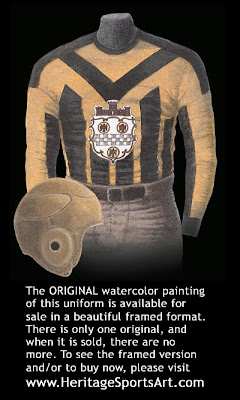
As you can see from the 1933 painting, this inaugural ’33 Pittsburgh Pirates jersey had various stripes - which were actually raised felt. These felt strips allowed the ball carrier to get a better purchase on the ball and thus keep it that much more securely.
If you look closely at the 1993 jersey, you’ll see quite a complicated “crest”, which is actually the ‘Arms of the City of Pittsburgh’. We had quite a time researching this as to the best of our ability to tell, there are no actual 1933 jerseys still in existence, and the few photos that exist don’t show the crest in too fine a detail.
In researching this jersey, we relied on newspaper articles that confirmed it was the city of Pittsburgh crest, and then we found samples of the crest as it appeared in the early 30’s. We then matched the crest to the jersey photos, and came up with the likeness shown in this painting.
In 1994, when the NFL was commemorating its 75th anniversary, all teams wore ‘throwback’ jerseys at one time or another. The Steelers chose to honor the 1933 team and re-created the 1933 jersey. The only problem was that they ran into the same sort of roadblock we did, thus the NFL had to do a bit of guessing as to what the crest looked like.
Thus the ’33 jersey is truly an elusive football gem - if anybody knows anything about the existence of one of these jerseys, you should contact the Pro Football Hall of Fame in Canton, Ohio – they would love to hear from you!
As for the 1933 team, they finished 3-6-2 and in 5th place in the 5 team NFL East. And things wouldn’t get much better for a while. In fact, the Pirates/Steelers wouldn’t finish above .500 until 1942 when they went 7-4.
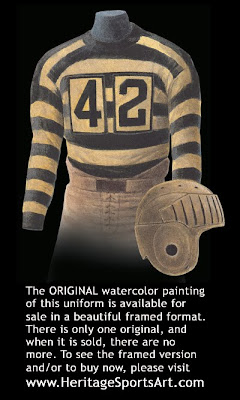
The 1934 jersey was also highly unique – note the horizontal striping across the entire jersey, including the sleeves, and the stylized numbers on the front – something not seen on any other Pirates/Steelers jersey or any other NFL team for that matter. Note also the hip-height, kidney-protecting pants. Also of note, look at the unique striping pattern on the ’34 helmet.
The 1934 Pirates/Steelers finished 2-10, once again in 5th in the NFL East.
Just four years later, in 1938, Rooney made Colorado All-America Byron "Whizzer" White the NFL's first "big money" player with a $15,800 contract (this is the same Whizzer White who would go on to become a member of the supreme court).
New info as of October 2012:
Please read this terrific 1934 Pittsburgh Steelers uniform article written by the amazing Tim Brulia. Tim was assisted in his research by his Gridiron Uniform Database partners Rob Holecko and Bill Schaefer.
It explains a great deal about the 1934 jersey and what the Pirates (as the Steelers were then known) did and didn't wear that season.
Great work by the Gridiron database team!
-------------------------------------------------------------------------------------------------
 1943
1943
World War II is in full force. To help maintain high morale throughout the country, the NFL, like Major League Baseball, decides to carry on at the advice of none other than President of the United States. Briefly summarized, he said that the games of baseball and football were too important to the people. Carrying on with the games would boost the morale of the entire Country, and get their minds off of the war effort for a short time.
Fielding players and trying to survive the financial effects of the war – proves to be an enormous challenge. The end result, in 1943, was that the state of Pennsylvania sees its two NFL franchises (the Steelers and the Philadelphia Eagles) merge – unofficially being dubbed the ‘Steagles’, and donning the ‘Eagle’ green & white. In 1944, the Steelers would merge again, this time with the Chicago Cardinals – forming the Card-Pitts.
The 1943 Steagles play their games both in Pittsburgh and in Philadelphia, and finish the season 5-4-1, only their second winning season since the team began in 1933 (1942 was the first winning season).
Of note: It wasn’t until 1940 that owner Art Rooney changed the name to the ‘Steelers’ – suggested by the team’s ticket manager’s wife – to reflect ties to the city’s steel industry.
-------------------------------------------------------------------------------------------------
 1954
1954
The evolution to the ‘modern’ and recognizable look of NFL jerseys and helmets can be seen in this ’54 uniform. The jersey has the more ‘traditional’ horizontal striping on the sleeves, while the helmet is no longer leather but instead it’s a hard plastic shell. Note the lack of a face mask on the helmet, somewhat remarkable given the fact that players in the 50’s were increasingly large. The question of whether or not to use a face mask was up to the individual player, and I can think of at least one, Bobby Layne, who didn’t wear a face mask as late as the 1960 season.
As proud and successful as the Steelers of the 70’s were, we can’t say the same for their ancestors. In the 30’s they didn’t have a single season over .500; in the 40’s they had 4 winning seasons; in the 50’s they only had 2 seasons over .500; and in the 60’s they only had 2 wining seasons as well – for a total of 8 winning seasons in 37 years. Thus when we report that the 1954 Steelers went 5-7good for 4th in the 6 team NFL East, we shouldn’t be overly surprised. Please bring on the 70’s!!!
-------------------------------------------------------------------------------------------------
 1960
1960
The 1960 Steelers were led by 34 year old veteran Bobby Layne, one of the brighter lights to don a Steelers jersey in this era. Layne was a slightly pudgy, lovable but tough quarterback who had been through the wars with the Bears, the New York Bulldogs and for 8 years the Detroit Lions.
After leading the Steelers to consecutive winning seasons in 1958 (7-4-1) and 1959 (6-5-1), Layne can’t do it all and the Steelers fall to 5-6-1 in 1960. And thus the Steelers’ woes continue – from 1933 to 1971 the Steelers make the playoffs a grand total of one time – in 1947. Yikes…
A few points of interest about the 1960 jersey: note the unique color of the Steelers’ pants, as well as the black-yellow-black stripes on the side of the pants. Note also the fact that the helmet depicted now has a face mask, even though quarterback Bobby Layne still went without one in the 1960 season. Also note that the 1960 helmet did not have a logo on it – this began in 1962, and even then only on the right side of the helmet. Finally, note how relatively tight the jersey was in 1960.
From 1957 to 1963 the Steelers were led by quarterback Bobby Layne, defensive tackle Ernie Stautner and running back John Henry Johnson, and they considered themselves were legitimate division contenders. But the "dynasty years," which coincided with the team's move to the AFC at the time of AFL-NFL merger, were still a decade away.
-------------------------------------------------------------------------------------------------
 1963
1963
What a unique, artistic and elegant-looking jersey! Notice the yellow/gold diamonds (and overlaid numbers) on the upper sleeve. The Hall of Fame has a version of this jersey, and it’s interesting to see that the yellow diamond has virtually faded away over the course of time, to the point that you don’t even notice it unless you’re looking for it! Note also the small black collar and sleeve cuffs.
If you look closely at the helmet, you’ll notice numbers on the front, sandwiching the yellow/gold stripe that runs from front to back of the helmet. Of special note, if you could see the right side of the helmet, you’d see the traditional 3-point Steelers logo – a marking that has graced the right side of Steelers helmets to this day! The 3 points not only represent ‘three rivers’, but are also the US Steel logo. Die-hard Steelers fans know that this logo is only on the right side of the helmet. The story goes that when the logo was proposed in 1962, owner Art Rooney wasn’t 100% sure if he liked the logo – so he had it placed on the right side only! The tradition has been upheld ever since.
And the Steelers record in 1963? A terrific 7-4-3 – one of only 8 winning seasons between 1933 (when the team was founded) and 1971. But as good a record as 7-4-3 seems, the Steelers finished in 4th in the NFL East, a long way away from a playoff berth – for many years the only playoff action came when the NFL Eastern and NFL Western champions met for the NFL Championship, meaning there was but one playoff game each year.
As proud and successful as the Steelers of the 70’s were, we can’t say the same for their ancestors. In the 30’s they didn’t have a single season over .500; in the 40’s they had 4 winning seasons; in the 50’s they only had 2 seasons over .500; and in the 60’s they only had 2 wining seasons as well – for a total of 8 winning seasons in 37 years. They can’t bring on the 70’s soon enough!!!
-------------------------------------------------------------------------------------------------
 1967
1967
Much like the 1963 jersey, the 1967 black home jersey is very simple in design, but it works. Featuring a yellow/gold, diamond shaped ‘yoke’ on the shoulders and neck of this year’s sweater, this jersey is one of our favorites.
Though a few NFL teams have adopted the ‘yoke’ look over the course of team history, no team but the Steelers have used it in a diamond shape!
Note: This is the first time we have shown the Steelers now famous Steel logo. With respect to the Steelers now famous Steel logo, the 3-point Steelers logo was first worn by the Steelers midway through the 1962 season (Nov 18, 1962) and has graced the right side of Steelers helmets ever since. The 3 points not only represent the ‘three rivers’ that meet in Pittsburgh, but were also a virtual direct copy, and tribute, to the US Steel logo that was introduced in 1960 - see here for more info. Die-hard Steelers fans know that this logo is only displayed on the right side of the helmet. The story goes that when the logo was proposed in 1962, owner Art Rooney wasn’t 100% sure if he liked the logo – so he had it placed on the right side only. The tradition has been upheld ever since.
Here is the US Steel logo first introduced by U.S. Steel and now a trademark of the American Iron and Steel Institute:

As much as we love this jersey, the team does no better than a 4-9-1 record. And 1968 was worse – the Steelers would go 2-11-1, and then in 1969 they hit rock bottom as they went 1-13-0. Thank goodness the 70’s are now knocking on the door.
-------------------------------------------------------------------------------------------------
 1974
1974
Nirvana!
Where do we begin to tell the story? We’ll let the scores do most of the talking…
9/15/74 Colts 0 Steelers 30
9/22/74 Steelers 35 Broncos 35* (Overtime)
9/29/74 Raiders 17 Steelers 0
10/6/74 Steelers 13 Oilers 7
10/13/74 Steelers 34 Chiefs 24
10/20/74 Browns 16 Steelers 20
10/28/74 Falcons 17 Steelers 24
11/3/74 Eagles 0 Steelers 27
11/10/74 Steelers 10 Bengals 17
11/17/74 Steelers 26 Browns 16
11/25/74 Steelers 28 Saints 7
12/1/74 Oilers 13 Steelers 10
12/8/74 Steelers 21 Patriots 17
12/14/74 Bengals 3 Steelers 27
Playoffs:
12/22/74 Bills 14 Steelers 32
12/29/74 Steelers 24 Raiders 13
1/12/75 Steelers 16 Vikings 6
January 12, 1975 – Chuck Noll’s 10-3-1 Steelers conclude a Cinderella season by defeating Minnesota 16-6 in front of 80,997 fans in Tulane Stadium to capture Super Bowl IX, thus ending 42 years of futility.
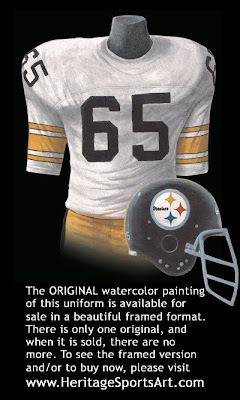
This road white jersey is synonymous with names such as Bradshaw, Lambert, Ham, Greene, Swann, Super Bowl IX MVP Franco Harris and many more. This remarkable group of talent would help the Steelers garner an astounding 4 Super Bowl victories in the 70’s – 1974, 1975, 1978, 1979. Note that the uniform numbers on the sleeves have made their way higher on the jersey sleeve. Note also the multiple sleeve stripes.
-------------------------------------------------------------------------------------------------
 1975
1975
Here we go again!
Hard on the heels of their 1974 success, the 1975 Steelers pick right up where they left off, going 12-2 in the regular season, then knocking off the Colts 28-10 followed by the ever present Raiders 16-10. Then in one of the better Super Bowl games, the Steelers hold off the late charging Cowboys 21-17 in front of 80,017 fans in Super Bowl X at the Orange Bowl in Miami. This time around, Lynn Swann carried home the game MVP hardware.
You’ll notice a patch on this 1975 jersey. This is an American Bicentennial patch that is located on the upper left part of the chest, and it was only worn in Super Bowl X on January 18, 1976 as part of the American Bicentennial celebrations.
-------------------------------------------------------------------------------------------------

 1978 and 1979
What a ride!
After a two year hiatus, the 1978 Steelers do it again.
After compiling a franchise best record 14-2 in the regular season, the Steelers beat Denver 33-10 and Houston 34-5 on route to Super Bowl XIII. Just like 1975, the Steelers face the Cowboys, and just like 1975, the Cowboys mount a large charge to make the game quite close, but when all was said and done the Steelers defeated the Cowboys 35-31 in Miami on January 21, 1979.
In fact, the Steelers of the 70’s compile a remarkable record – from 1972 to 1979 they go a combined 88-27-1 in the regular season, and another 14-4 in the playoffs for a total record of 102-31-1. The numbers speak for themselves – this was a truly awesome team.
The only significant difference between this home black uniform and the 1975 version is the fact that this uniform features a black belt and there is no longer a bicentennial patch sewn onto the jersey.
And we’d better tell the story of the 1979 Steelers, who complete the decade by winning their 4th Super Bowl in four tries – 1974, 1975, 1978 and 1979 – all this after a grand total of just 8 winning seasons and just one playoff appearance in the 39 years from 1933 to 1971.
Of interest: Here you can see the left side of the helmet. If you could see the right side of the helmet, you’d see the traditional 3-point Steelers logo – a marking that has graced the right side of Steelers’ helmets from 1933 to the present! The 3 points not only represent ‘three rivers’, but are also the US Steel logo. Die-hard Steelers fans know that this logo is only on the right side of the helmet. The story goes that when the logo was proposed in 1962, owner Art Rooney wasn’t 100% sure if he liked the logo – so he had it placed on the right side only! The tradition has been upheld ever since.
-------------------------------------------------------------------------------------------------
 1988
1988
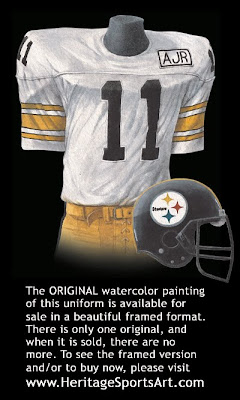
This jersey holds a special place in the hearts of all Steelers fans. The AJR patch on the left shoulder honors the passing of Pittsburgh owner and icon Art “The Chief” Rooney. Rooney will fondly be remembered for being a smooth and unbelievably lucky gambler who invested $2,500 into an NFL franchise, and nearly 40 years later, turned it into a dynasty. A staple in the football community, it is not uncommon to mention Rooney in the same breath as Chicago Bear legend – George Halas. To this day, the Rooney family still helms the Steelers football club in the person of President Daniel M. Rooney.
The Steelers of the 80’s are an above .500 team – they finished .500 or above 7 times – but after the truly heady days of the 70’s, I’m not sure they could do anything for an encore. The 1988 Steelers, for instance, finished 5-11 and far out of the playoffs.
-------------------------------------------------------------------------------------------------
 2000
2000
Note the rounder, less ‘varsity-esque’ fashion of this jersey’s numbers – a transformation that took place back in ’97. This rounded numbering style is most often associated with the Chicago Bears, who have used it for almost 50 years. Other teams have used it from time to time, including the 1960 Raiders.
Note also the small NFL logo just below the neckline. If you look closely at almost all NFL uniforms worn from 1991 on, you’ll notice this same small NFL shield patch on the jersey’s neckline. Most NFL uniforms added the NFL logo patch to the neck, and to the upper left thigh of the pants, beginning in 1991. The only major exception to this practice was in 1994 when the teams wore their throwback uniforms – in these cases, the teams did not wear the NFL shield patch.
Did you spot the mini Steelers logo on the left shoulder? Not many teams have placed their logo on their jersey – it’s usually reserved for sides of the helmet (which, in the Steelers’ case, is only on the right side).
The 2000 version of the Steelers finish up a respectable 9-7, good, but not good enough to make the playoffs.
-------------------------------------------------------------------------------------------------
 2004
2004
The NFL's longest tenured coach, Bill Cowher, faced monumental challenges going into his 13th season in Pittsburgh following a 6-10 season in 2003, ending a two-year run atop the AFC North. His biggest challenges were: pass defense, the running game and quarterback.
The Steelers looked for answers in the free agent market and the draft. They selected QB Ben Roethlisberger, an underclassman from Miami of Ohio, in the first round knowing that the incumbent Tommy Maddox was not a long-term solution. They gave their running game a facelift, by ousting prospect Amos Zereoue and signing all-purpose tough guy Duce Staley. Staley and Jerome “the Bus” Bettis would share the ball carrying duties. On defense, younger, faster players like CB Ricardo Colclough and LB Dedrick Roper replaced aging veterans like Dewayne Washington and Jason Gildon. Unfortunately, younger also means untested, so Cowher knew the playoffs were far from being guaranteed.
The Steelers started the season on the right foot with a home win against the Oakland Raiders. In week 2 the team looked like it suffered a major setback when Tommy Maddox went down with a leg injury in a road game against the Baltimore Ravens; Roethlisberger stepped and played the rest of the game. The Steelers lost the game, but remarkably that would be the last defeat they would suffer the rest of the regular season. From that loss the team came together and Roethlisberger proved he was ready for the big leagues, finishing the season with 196 completions for 2621 yards, 17 TD and 11 interceptions, and their defense allowed opposing teams more than 20 points in only three games the rest of the way.
The end result: a franchise best 15-1 record and a trip to the playoffs as the AFC’s top seed. In the playoffs the team that rolled through the regular season struggled and seemed a little over-their-heads in the playoffs. After a first week bye, the Steelers faced the Jets in a Divisional playoff and narrowly won 20-17 in overtime, and this was after Jets PK Doug Brien missed his second chance at a game winning field goal. In the AFC Championship game their inexperience showed as they lost 41-27 at home to the defending Super Bowl champion New England Patriots. The Patriots would go on to win Super Bowl XXXIX.
It was interesting to note that despite having the NFL’s best record at 15-1, the Steelers had no players selected to the AFC Pro Bowl team.
This 2004 road jersey continues a look the team established in 1997 - the black numeral style featured on this jersey is similar to the “rounded” numeral style the Chicago Bears use. It is used for the numbers on the front and back of the jersey as well as the “TV” numbers on the shoulders. The sleeves are decorated with the traditional Steelers black white and gold striping. Please also note that the team’s logo appears on a patch on the left shoulder of the jersey, an unusual look for NFL jerseys.
Please also note the fact that the helmet, as shown here, has no logo on the left side. As written earlier in this text, if you could see the right side of the helmet, you’d see the traditional 3-point Steelers logo – a marking that has graced the right side of Steelers helmets since 1962. The 3 points not only represent ‘three rivers’, but were also the US Steel logo. Die-hard Steelers fans know that this logo is only on the right side of the helmet. The story goes that when the logo was proposed in 1962, owner Art Rooney wasn’t 100% sure if he liked the logo – so he had it placed on the right side only! The tradition has been upheld ever since and that’s why the left side has no logo.
-------------------------------------------------------------------------------------------------
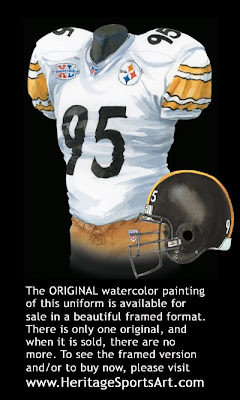 2005
2005
What a glorious surprise! After twelve games in the 2005 season, the Steelers were 7-5 and in the midst of a three game losing streak. Even die hard fans were just about ready to write off the 2005 season. What happened after the twelfth game was the stuff of legend - the Steelers closed out the regular season with four straight wins and they needed all four just to make the playoffs as a wildcard team. Then they ran the table in the playoffs:
- In the AFC Wildcard game they went into Cincinnati and beat the Bengals 31-17
- In the AFC Divisional playoff they went into Indianapolis and beat the highly ranked Colts 21-18
- In the AFC Championship game they went into Denver and beat the Broncos 34-17.
- And in the Super Bowl, they manhandled the Seattle Seahawks 21-10 for the franchise’s 5th Super Bowl Victory.
Along the way many heroes were made and reputations cemented - from Ben Roethlisberger’s remarkable sophomore season (168 for 268) to Jerome Bettis’ inspirational runs when it really mattered to Hines Ward’s 11 regular season + 3 post season TD’s to Troy Polamalu’s Pro Bowl season - from Game 12 on, the Steelers were truly a team of destiny.
On the upper right chest of the 2005 white jersey, you will see the Super Bowl XL patch worn by both teams in the Super Bowl. You will also see the Steelers logo in the upper left chest area, as well as the now familiar NFL Equipment patch under the “V” of the neck and on the upper left thigh of the pants.
Please also note the fact that the helmet, as shown here, has no logo on the left side. As written earlier in this text, if you could see the right side of the helmet, you’d see the traditional 3-point Steelers logo – a marking that has graced the right side of Steelers helmets since 1962. The 3 points not only represent ‘three rivers’, but were also the US Steel logo. Die-hard Steelers fans know that this logo is only on the right side of the helmet. The story goes that when the logo was proposed in 1962, owner Art Rooney wasn’t 100% sure if he liked the logo – so he had it placed on the right side only! The tradition has been upheld ever since and that’s why the left side has no logo.
-------------------------------------------------------------------------------------------------
 2007
2007
Text not yet written.
-------------------------------------------------
Celebrate the Steelers' uniform history by owning a piece of history:
If you love the Pittsburgh Steelers and the history of the Steelers franchise, you might really love to own an original piece of artwork celebrating the team's historic uniforms as seen in the poster at the top of this blog - you can actually own one of those original pieces of art! There are only 15 pieces of original art available for sale, and when these 15 are sold, that's it, they're all sold out.
These original watercolor paintings would make a great gift (birthday gift, anniversary gift, retirement gift, Christmas gift, etc.) for someone you love or even a great gift for yourself (one of these framed pieces would look fantastic in your home or office). Each piece can be bought one of three ways:
1. As unframed art that you could have framed or mounted yourself (the one on the left)
2. Framed in our "Classic" framed version (the middle version)
3. Framed in our "Deluxe" framed version (the version on the right)

If you would like more information about this great artwork including the three ways you could purchase each piece, please visit our Pittsburgh Steelers YouTube video at www.youtube.com/watch?v=WVxuSE116Dw or go directly to the artwork website www.heritagesportsart.com/Pittsburgh%20Steelers-c127/ where you can see and purchase the artwork.
And if someone you know loves the history of sports uniforms (but maybe another team) and loves great art, please let them know that we have over 1500 pieces of great original artwork for sale at www.heritagesportsart.com (all NFL teams, all MLB teams, all NHL teams, all CFL teams, select NCAA football teams) or check out each team's video at the Heritage Sports Art YouTube Channel www.youtube.com/user/ssillcox
And please search my blog archive http://heritagejerseys.blogspot.com/ for other blogs on the history of the Steelers.
---------------------------------------------
This blog was written by Scott Sillcox and was last updated August 18, 2010. I have tried to ensure the accuracy of the information, but I am human and can make mistakes. If you believe I have made a mistake, please let me know by email at ssillcox@rogers.com !
Many thanks!!!
Scott
-------------------------------------------------------------------------------------------------


Any story about the Steelers has to begin with Art Rooney.
Art J. Rooney (aka ‘The Chief’) was the prototypical playboy: a slick card player, a cunning ‘horseplayer’, and a savvy sports promoter. He purchased an NFL franchise in 1933 – for $2,500, and converted his semi-pro team, known as the “Majestics” (for the Majestic Radios Athletic Club), into the Pirates - naming the team the same as its baseball counterparts! It wasn’t until 1940 that Rooney changed the name to the ‘Steelers’ – suggested by the team’s ticket manager’s wife – to reflect ties to the city’s steel industry. The Steelers are steeped in tradition, and in fact are the 6th oldest team in the NFL today.
As you can see from the 1933 painting, this inaugural ’33 Pittsburgh Pirates jersey had various stripes - which were actually raised felt. These felt strips allowed the ball carrier to get a better purchase on the ball and thus keep it that much more securely.
If you look closely at the 1993 jersey, you’ll see quite a complicated “crest”, which is actually the ‘Arms of the City of Pittsburgh’. We had quite a time researching this as to the best of our ability to tell, there are no actual 1933 jerseys still in existence, and the few photos that exist don’t show the crest in too fine a detail.
In researching this jersey, we relied on newspaper articles that confirmed it was the city of Pittsburgh crest, and then we found samples of the crest as it appeared in the early 30’s. We then matched the crest to the jersey photos, and came up with the likeness shown in this painting.
In 1994, when the NFL was commemorating its 75th anniversary, all teams wore ‘throwback’ jerseys at one time or another. The Steelers chose to honor the 1933 team and re-created the 1933 jersey. The only problem was that they ran into the same sort of roadblock we did, thus the NFL had to do a bit of guessing as to what the crest looked like.
Thus the ’33 jersey is truly an elusive football gem - if anybody knows anything about the existence of one of these jerseys, you should contact the Pro Football Hall of Fame in Canton, Ohio – they would love to hear from you!
As for the 1933 team, they finished 3-6-2 and in 5th place in the 5 team NFL East. And things wouldn’t get much better for a while. In fact, the Pirates/Steelers wouldn’t finish above .500 until 1942 when they went 7-4.
The 1934 jersey was also highly unique – note the horizontal striping across the entire jersey, including the sleeves, and the stylized numbers on the front – something not seen on any other Pirates/Steelers jersey or any other NFL team for that matter. Note also the hip-height, kidney-protecting pants. Also of note, look at the unique striping pattern on the ’34 helmet.
The 1934 Pirates/Steelers finished 2-10, once again in 5th in the NFL East.
Just four years later, in 1938, Rooney made Colorado All-America Byron "Whizzer" White the NFL's first "big money" player with a $15,800 contract (this is the same Whizzer White who would go on to become a member of the supreme court).
New info as of October 2012:
Please read this terrific 1934 Pittsburgh Steelers uniform article written by the amazing Tim Brulia. Tim was assisted in his research by his Gridiron Uniform Database partners Rob Holecko and Bill Schaefer.
It explains a great deal about the 1934 jersey and what the Pirates (as the Steelers were then known) did and didn't wear that season.
Great work by the Gridiron database team!
-------------------------------------------------------------------------------------------------

World War II is in full force. To help maintain high morale throughout the country, the NFL, like Major League Baseball, decides to carry on at the advice of none other than President of the United States. Briefly summarized, he said that the games of baseball and football were too important to the people. Carrying on with the games would boost the morale of the entire Country, and get their minds off of the war effort for a short time.
Fielding players and trying to survive the financial effects of the war – proves to be an enormous challenge. The end result, in 1943, was that the state of Pennsylvania sees its two NFL franchises (the Steelers and the Philadelphia Eagles) merge – unofficially being dubbed the ‘Steagles’, and donning the ‘Eagle’ green & white. In 1944, the Steelers would merge again, this time with the Chicago Cardinals – forming the Card-Pitts.
The 1943 Steagles play their games both in Pittsburgh and in Philadelphia, and finish the season 5-4-1, only their second winning season since the team began in 1933 (1942 was the first winning season).
Of note: It wasn’t until 1940 that owner Art Rooney changed the name to the ‘Steelers’ – suggested by the team’s ticket manager’s wife – to reflect ties to the city’s steel industry.
-------------------------------------------------------------------------------------------------

The evolution to the ‘modern’ and recognizable look of NFL jerseys and helmets can be seen in this ’54 uniform. The jersey has the more ‘traditional’ horizontal striping on the sleeves, while the helmet is no longer leather but instead it’s a hard plastic shell. Note the lack of a face mask on the helmet, somewhat remarkable given the fact that players in the 50’s were increasingly large. The question of whether or not to use a face mask was up to the individual player, and I can think of at least one, Bobby Layne, who didn’t wear a face mask as late as the 1960 season.
As proud and successful as the Steelers of the 70’s were, we can’t say the same for their ancestors. In the 30’s they didn’t have a single season over .500; in the 40’s they had 4 winning seasons; in the 50’s they only had 2 seasons over .500; and in the 60’s they only had 2 wining seasons as well – for a total of 8 winning seasons in 37 years. Thus when we report that the 1954 Steelers went 5-7good for 4th in the 6 team NFL East, we shouldn’t be overly surprised. Please bring on the 70’s!!!
-------------------------------------------------------------------------------------------------

The 1960 Steelers were led by 34 year old veteran Bobby Layne, one of the brighter lights to don a Steelers jersey in this era. Layne was a slightly pudgy, lovable but tough quarterback who had been through the wars with the Bears, the New York Bulldogs and for 8 years the Detroit Lions.
After leading the Steelers to consecutive winning seasons in 1958 (7-4-1) and 1959 (6-5-1), Layne can’t do it all and the Steelers fall to 5-6-1 in 1960. And thus the Steelers’ woes continue – from 1933 to 1971 the Steelers make the playoffs a grand total of one time – in 1947. Yikes…
A few points of interest about the 1960 jersey: note the unique color of the Steelers’ pants, as well as the black-yellow-black stripes on the side of the pants. Note also the fact that the helmet depicted now has a face mask, even though quarterback Bobby Layne still went without one in the 1960 season. Also note that the 1960 helmet did not have a logo on it – this began in 1962, and even then only on the right side of the helmet. Finally, note how relatively tight the jersey was in 1960.
From 1957 to 1963 the Steelers were led by quarterback Bobby Layne, defensive tackle Ernie Stautner and running back John Henry Johnson, and they considered themselves were legitimate division contenders. But the "dynasty years," which coincided with the team's move to the AFC at the time of AFL-NFL merger, were still a decade away.
-------------------------------------------------------------------------------------------------

What a unique, artistic and elegant-looking jersey! Notice the yellow/gold diamonds (and overlaid numbers) on the upper sleeve. The Hall of Fame has a version of this jersey, and it’s interesting to see that the yellow diamond has virtually faded away over the course of time, to the point that you don’t even notice it unless you’re looking for it! Note also the small black collar and sleeve cuffs.
If you look closely at the helmet, you’ll notice numbers on the front, sandwiching the yellow/gold stripe that runs from front to back of the helmet. Of special note, if you could see the right side of the helmet, you’d see the traditional 3-point Steelers logo – a marking that has graced the right side of Steelers helmets to this day! The 3 points not only represent ‘three rivers’, but are also the US Steel logo. Die-hard Steelers fans know that this logo is only on the right side of the helmet. The story goes that when the logo was proposed in 1962, owner Art Rooney wasn’t 100% sure if he liked the logo – so he had it placed on the right side only! The tradition has been upheld ever since.
And the Steelers record in 1963? A terrific 7-4-3 – one of only 8 winning seasons between 1933 (when the team was founded) and 1971. But as good a record as 7-4-3 seems, the Steelers finished in 4th in the NFL East, a long way away from a playoff berth – for many years the only playoff action came when the NFL Eastern and NFL Western champions met for the NFL Championship, meaning there was but one playoff game each year.
As proud and successful as the Steelers of the 70’s were, we can’t say the same for their ancestors. In the 30’s they didn’t have a single season over .500; in the 40’s they had 4 winning seasons; in the 50’s they only had 2 seasons over .500; and in the 60’s they only had 2 wining seasons as well – for a total of 8 winning seasons in 37 years. They can’t bring on the 70’s soon enough!!!
-------------------------------------------------------------------------------------------------

Much like the 1963 jersey, the 1967 black home jersey is very simple in design, but it works. Featuring a yellow/gold, diamond shaped ‘yoke’ on the shoulders and neck of this year’s sweater, this jersey is one of our favorites.
Though a few NFL teams have adopted the ‘yoke’ look over the course of team history, no team but the Steelers have used it in a diamond shape!
Note: This is the first time we have shown the Steelers now famous Steel logo. With respect to the Steelers now famous Steel logo, the 3-point Steelers logo was first worn by the Steelers midway through the 1962 season (Nov 18, 1962) and has graced the right side of Steelers helmets ever since. The 3 points not only represent the ‘three rivers’ that meet in Pittsburgh, but were also a virtual direct copy, and tribute, to the US Steel logo that was introduced in 1960 - see here for more info. Die-hard Steelers fans know that this logo is only displayed on the right side of the helmet. The story goes that when the logo was proposed in 1962, owner Art Rooney wasn’t 100% sure if he liked the logo – so he had it placed on the right side only. The tradition has been upheld ever since.
Here is the US Steel logo first introduced by U.S. Steel and now a trademark of the American Iron and Steel Institute:

As much as we love this jersey, the team does no better than a 4-9-1 record. And 1968 was worse – the Steelers would go 2-11-1, and then in 1969 they hit rock bottom as they went 1-13-0. Thank goodness the 70’s are now knocking on the door.
-------------------------------------------------------------------------------------------------

Nirvana!
Where do we begin to tell the story? We’ll let the scores do most of the talking…
9/15/74 Colts 0 Steelers 30
9/22/74 Steelers 35 Broncos 35* (Overtime)
9/29/74 Raiders 17 Steelers 0
10/6/74 Steelers 13 Oilers 7
10/13/74 Steelers 34 Chiefs 24
10/20/74 Browns 16 Steelers 20
10/28/74 Falcons 17 Steelers 24
11/3/74 Eagles 0 Steelers 27
11/10/74 Steelers 10 Bengals 17
11/17/74 Steelers 26 Browns 16
11/25/74 Steelers 28 Saints 7
12/1/74 Oilers 13 Steelers 10
12/8/74 Steelers 21 Patriots 17
12/14/74 Bengals 3 Steelers 27
Playoffs:
12/22/74 Bills 14 Steelers 32
12/29/74 Steelers 24 Raiders 13
1/12/75 Steelers 16 Vikings 6
January 12, 1975 – Chuck Noll’s 10-3-1 Steelers conclude a Cinderella season by defeating Minnesota 16-6 in front of 80,997 fans in Tulane Stadium to capture Super Bowl IX, thus ending 42 years of futility.
This road white jersey is synonymous with names such as Bradshaw, Lambert, Ham, Greene, Swann, Super Bowl IX MVP Franco Harris and many more. This remarkable group of talent would help the Steelers garner an astounding 4 Super Bowl victories in the 70’s – 1974, 1975, 1978, 1979. Note that the uniform numbers on the sleeves have made their way higher on the jersey sleeve. Note also the multiple sleeve stripes.
-------------------------------------------------------------------------------------------------

Here we go again!
Hard on the heels of their 1974 success, the 1975 Steelers pick right up where they left off, going 12-2 in the regular season, then knocking off the Colts 28-10 followed by the ever present Raiders 16-10. Then in one of the better Super Bowl games, the Steelers hold off the late charging Cowboys 21-17 in front of 80,017 fans in Super Bowl X at the Orange Bowl in Miami. This time around, Lynn Swann carried home the game MVP hardware.
You’ll notice a patch on this 1975 jersey. This is an American Bicentennial patch that is located on the upper left part of the chest, and it was only worn in Super Bowl X on January 18, 1976 as part of the American Bicentennial celebrations.
-------------------------------------------------------------------------------------------------


What a ride!
After a two year hiatus, the 1978 Steelers do it again.
After compiling a franchise best record 14-2 in the regular season, the Steelers beat Denver 33-10 and Houston 34-5 on route to Super Bowl XIII. Just like 1975, the Steelers face the Cowboys, and just like 1975, the Cowboys mount a large charge to make the game quite close, but when all was said and done the Steelers defeated the Cowboys 35-31 in Miami on January 21, 1979.
In fact, the Steelers of the 70’s compile a remarkable record – from 1972 to 1979 they go a combined 88-27-1 in the regular season, and another 14-4 in the playoffs for a total record of 102-31-1. The numbers speak for themselves – this was a truly awesome team.
The only significant difference between this home black uniform and the 1975 version is the fact that this uniform features a black belt and there is no longer a bicentennial patch sewn onto the jersey.
And we’d better tell the story of the 1979 Steelers, who complete the decade by winning their 4th Super Bowl in four tries – 1974, 1975, 1978 and 1979 – all this after a grand total of just 8 winning seasons and just one playoff appearance in the 39 years from 1933 to 1971.
Of interest: Here you can see the left side of the helmet. If you could see the right side of the helmet, you’d see the traditional 3-point Steelers logo – a marking that has graced the right side of Steelers’ helmets from 1933 to the present! The 3 points not only represent ‘three rivers’, but are also the US Steel logo. Die-hard Steelers fans know that this logo is only on the right side of the helmet. The story goes that when the logo was proposed in 1962, owner Art Rooney wasn’t 100% sure if he liked the logo – so he had it placed on the right side only! The tradition has been upheld ever since.
-------------------------------------------------------------------------------------------------

This jersey holds a special place in the hearts of all Steelers fans. The AJR patch on the left shoulder honors the passing of Pittsburgh owner and icon Art “The Chief” Rooney. Rooney will fondly be remembered for being a smooth and unbelievably lucky gambler who invested $2,500 into an NFL franchise, and nearly 40 years later, turned it into a dynasty. A staple in the football community, it is not uncommon to mention Rooney in the same breath as Chicago Bear legend – George Halas. To this day, the Rooney family still helms the Steelers football club in the person of President Daniel M. Rooney.
The Steelers of the 80’s are an above .500 team – they finished .500 or above 7 times – but after the truly heady days of the 70’s, I’m not sure they could do anything for an encore. The 1988 Steelers, for instance, finished 5-11 and far out of the playoffs.
-------------------------------------------------------------------------------------------------

Note the rounder, less ‘varsity-esque’ fashion of this jersey’s numbers – a transformation that took place back in ’97. This rounded numbering style is most often associated with the Chicago Bears, who have used it for almost 50 years. Other teams have used it from time to time, including the 1960 Raiders.
Note also the small NFL logo just below the neckline. If you look closely at almost all NFL uniforms worn from 1991 on, you’ll notice this same small NFL shield patch on the jersey’s neckline. Most NFL uniforms added the NFL logo patch to the neck, and to the upper left thigh of the pants, beginning in 1991. The only major exception to this practice was in 1994 when the teams wore their throwback uniforms – in these cases, the teams did not wear the NFL shield patch.
Did you spot the mini Steelers logo on the left shoulder? Not many teams have placed their logo on their jersey – it’s usually reserved for sides of the helmet (which, in the Steelers’ case, is only on the right side).
The 2000 version of the Steelers finish up a respectable 9-7, good, but not good enough to make the playoffs.
-------------------------------------------------------------------------------------------------

The NFL's longest tenured coach, Bill Cowher, faced monumental challenges going into his 13th season in Pittsburgh following a 6-10 season in 2003, ending a two-year run atop the AFC North. His biggest challenges were: pass defense, the running game and quarterback.
The Steelers looked for answers in the free agent market and the draft. They selected QB Ben Roethlisberger, an underclassman from Miami of Ohio, in the first round knowing that the incumbent Tommy Maddox was not a long-term solution. They gave their running game a facelift, by ousting prospect Amos Zereoue and signing all-purpose tough guy Duce Staley. Staley and Jerome “the Bus” Bettis would share the ball carrying duties. On defense, younger, faster players like CB Ricardo Colclough and LB Dedrick Roper replaced aging veterans like Dewayne Washington and Jason Gildon. Unfortunately, younger also means untested, so Cowher knew the playoffs were far from being guaranteed.
The Steelers started the season on the right foot with a home win against the Oakland Raiders. In week 2 the team looked like it suffered a major setback when Tommy Maddox went down with a leg injury in a road game against the Baltimore Ravens; Roethlisberger stepped and played the rest of the game. The Steelers lost the game, but remarkably that would be the last defeat they would suffer the rest of the regular season. From that loss the team came together and Roethlisberger proved he was ready for the big leagues, finishing the season with 196 completions for 2621 yards, 17 TD and 11 interceptions, and their defense allowed opposing teams more than 20 points in only three games the rest of the way.
The end result: a franchise best 15-1 record and a trip to the playoffs as the AFC’s top seed. In the playoffs the team that rolled through the regular season struggled and seemed a little over-their-heads in the playoffs. After a first week bye, the Steelers faced the Jets in a Divisional playoff and narrowly won 20-17 in overtime, and this was after Jets PK Doug Brien missed his second chance at a game winning field goal. In the AFC Championship game their inexperience showed as they lost 41-27 at home to the defending Super Bowl champion New England Patriots. The Patriots would go on to win Super Bowl XXXIX.
It was interesting to note that despite having the NFL’s best record at 15-1, the Steelers had no players selected to the AFC Pro Bowl team.
This 2004 road jersey continues a look the team established in 1997 - the black numeral style featured on this jersey is similar to the “rounded” numeral style the Chicago Bears use. It is used for the numbers on the front and back of the jersey as well as the “TV” numbers on the shoulders. The sleeves are decorated with the traditional Steelers black white and gold striping. Please also note that the team’s logo appears on a patch on the left shoulder of the jersey, an unusual look for NFL jerseys.
Please also note the fact that the helmet, as shown here, has no logo on the left side. As written earlier in this text, if you could see the right side of the helmet, you’d see the traditional 3-point Steelers logo – a marking that has graced the right side of Steelers helmets since 1962. The 3 points not only represent ‘three rivers’, but were also the US Steel logo. Die-hard Steelers fans know that this logo is only on the right side of the helmet. The story goes that when the logo was proposed in 1962, owner Art Rooney wasn’t 100% sure if he liked the logo – so he had it placed on the right side only! The tradition has been upheld ever since and that’s why the left side has no logo.
-------------------------------------------------------------------------------------------------

What a glorious surprise! After twelve games in the 2005 season, the Steelers were 7-5 and in the midst of a three game losing streak. Even die hard fans were just about ready to write off the 2005 season. What happened after the twelfth game was the stuff of legend - the Steelers closed out the regular season with four straight wins and they needed all four just to make the playoffs as a wildcard team. Then they ran the table in the playoffs:
- In the AFC Wildcard game they went into Cincinnati and beat the Bengals 31-17
- In the AFC Divisional playoff they went into Indianapolis and beat the highly ranked Colts 21-18
- In the AFC Championship game they went into Denver and beat the Broncos 34-17.
- And in the Super Bowl, they manhandled the Seattle Seahawks 21-10 for the franchise’s 5th Super Bowl Victory.
Along the way many heroes were made and reputations cemented - from Ben Roethlisberger’s remarkable sophomore season (168 for 268) to Jerome Bettis’ inspirational runs when it really mattered to Hines Ward’s 11 regular season + 3 post season TD’s to Troy Polamalu’s Pro Bowl season - from Game 12 on, the Steelers were truly a team of destiny.
On the upper right chest of the 2005 white jersey, you will see the Super Bowl XL patch worn by both teams in the Super Bowl. You will also see the Steelers logo in the upper left chest area, as well as the now familiar NFL Equipment patch under the “V” of the neck and on the upper left thigh of the pants.
Please also note the fact that the helmet, as shown here, has no logo on the left side. As written earlier in this text, if you could see the right side of the helmet, you’d see the traditional 3-point Steelers logo – a marking that has graced the right side of Steelers helmets since 1962. The 3 points not only represent ‘three rivers’, but were also the US Steel logo. Die-hard Steelers fans know that this logo is only on the right side of the helmet. The story goes that when the logo was proposed in 1962, owner Art Rooney wasn’t 100% sure if he liked the logo – so he had it placed on the right side only! The tradition has been upheld ever since and that’s why the left side has no logo.
-------------------------------------------------------------------------------------------------

Text not yet written.
-------------------------------------------------
Celebrate the Steelers' uniform history by owning a piece of history:
If you love the Pittsburgh Steelers and the history of the Steelers franchise, you might really love to own an original piece of artwork celebrating the team's historic uniforms as seen in the poster at the top of this blog - you can actually own one of those original pieces of art! There are only 15 pieces of original art available for sale, and when these 15 are sold, that's it, they're all sold out.
These original watercolor paintings would make a great gift (birthday gift, anniversary gift, retirement gift, Christmas gift, etc.) for someone you love or even a great gift for yourself (one of these framed pieces would look fantastic in your home or office). Each piece can be bought one of three ways:
1. As unframed art that you could have framed or mounted yourself (the one on the left)
2. Framed in our "Classic" framed version (the middle version)
3. Framed in our "Deluxe" framed version (the version on the right)

If you would like more information about this great artwork including the three ways you could purchase each piece, please visit our Pittsburgh Steelers YouTube video at www.youtube.com/watch?v=WVxuSE116Dw or go directly to the artwork website www.heritagesportsart.com/Pittsburgh%20Steelers-c127/ where you can see and purchase the artwork.
And if someone you know loves the history of sports uniforms (but maybe another team) and loves great art, please let them know that we have over 1500 pieces of great original artwork for sale at www.heritagesportsart.com (all NFL teams, all MLB teams, all NHL teams, all CFL teams, select NCAA football teams) or check out each team's video at the Heritage Sports Art YouTube Channel www.youtube.com/user/ssillcox
And please search my blog archive http://heritagejerseys.blogspot.com/ for other blogs on the history of the Steelers.
---------------------------------------------
This blog was written by Scott Sillcox and was last updated August 18, 2010. I have tried to ensure the accuracy of the information, but I am human and can make mistakes. If you believe I have made a mistake, please let me know by email at ssillcox@rogers.com !
Many thanks!!!
Scott


